




Flynn Reef is one of the outstanding Great Barrier Reef locations accessible from Cairns, known for beautiful coral gardens, clear tropical water and varied underwater terrain for both snorkelling and scuba diving.
What makes Flynn Reef particularly interesting is its diversity.
Shallow coral gardens allow snorkellers to explore a colourful living reef from the surface, while deeper areas reveal bommies, walls, overhangs, sandy sections and swim-throughs for scuba divers.
There isn’t one single underwater landscape here.
Move from one part of Flynn Reef to another and the environment can change completely.
That variety has made Flynn Reef a well-known destination for Cairns reef trips and an excellent example of why exploring the Great Barrier Reef means discovering individual reefs, not simply visiting one enormous reef.
What Makes Flynn Reef Special?
Flynn Reef combines impressive coral habitat with considerable variation in depth and underwater topography.
Some areas rise into shallow water where sunlight illuminates the coral and tropical fish below.
Elsewhere, the reef drops away into deeper water.
Coral bommies create isolated structures. Overhangs and crevices provide shelter for marine animals, while swim-throughs allow divers to move through the reef landscape rather than simply over it.
Established Flynn Reef sites include names such as Tracy’s Bommie, Gordon’s Mooring, Coral Gardens, Little Tracey, Tennis Court and Point Break.
Each represents a different part of the larger Flynn Reef system.
That means two people can visit Flynn Reef on different days, or even make two dives on the same day, and have quite different experiences.
Snorkelling at Flynn Reef
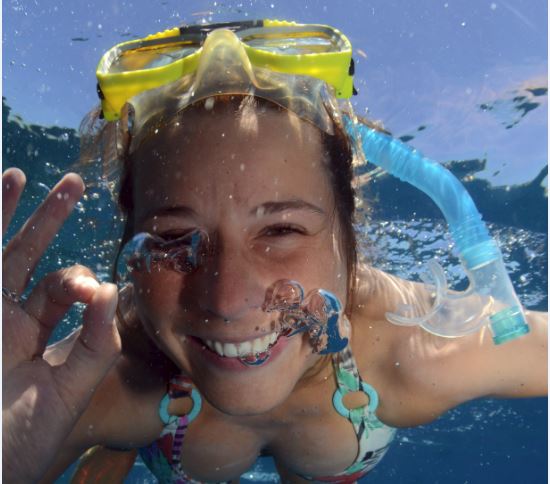
Flynn Reef can be excellent for Great Barrier Reef snorkelling.
Its shallow coral gardens allow snorkellers to look down across a complex underwater environment without needing to scuba dive.
In favourable conditions, sunlight penetrates the clear tropical water and illuminates the coral below.
Schools of small reef fish move across the reef.
Butterflyfish and angelfish search around coral formations.
Parrotfish graze across the reef.
And occasionally something larger appears from the blue.
The best approach is simple.
Don’t rush.
Float above one section of coral and watch what happens.
The longer you stay still, the more activity you begin to notice.
Scuba Diving at Flynn Reef
Below the surface, Flynn Reef becomes a very different environment.
Scuba divers can descend alongside coral formations, move around bommies and explore walls, overhangs, crevices and swim-throughs.
Your photograph captures this side of Flynn Reef particularly well.
Light enters through an opening in the reef while fish move between the darker coral structure and bright blue water outside.
For a diver, environments like this create a completely different sense of the reef.
You aren’t simply looking down at coral.
You are moving through the landscape it has created.
Flynn Reef’s Swim-Throughs and Overhangs
Swim-throughs are among the features that make reef diving particularly memorable.
Over thousands of years, the physical growth and erosion of reef structures can create openings, channels, crevices and sheltered areas.
These spaces also provide habitat.
Fish may congregate beneath overhangs or around entrances, while smaller creatures occupy cracks and protected surfaces.
For divers, moving carefully through an appropriate swim-through can reveal changing light, colour and marine life within a very short distance.
Any overhead environment should only be entered where it is appropriate to the diver’s certification, experience and the instructions of the supervising dive crew.
The reef will still be there if a particular section isn’t suitable for you.
Coral Gardens
Some Flynn Reef locations are known specifically for their coral gardens.
These areas contain a mixture of coral growth forms, creating an intricate underwater landscape.
Branching staghorn corals provide shelter for small fish.
Table and plate corals extend horizontally over the reef.
Large rounded coral colonies create substantial structures, while soft corals add movement to areas exposed to the current.
For snorkellers, these gardens can be particularly impressive because they often occur in relatively shallow water.
For divers, descending alongside them reveals just how three-dimensional a coral reef really is.
Tracy’s Bommie
Tracy’s Bommie is one of Flynn Reef’s recognised locations.
A bommie is an isolated coral formation rising from the surrounding seabed or reef platform.
These structures can become concentrated centres of marine activity.
Small fish use the coral for shelter.
Larger fish patrol around the outside.
Predators may pass through looking for feeding opportunities.
The surrounding water allows divers and snorkellers to appreciate the entire structure rather than seeing only a flat section of reef.
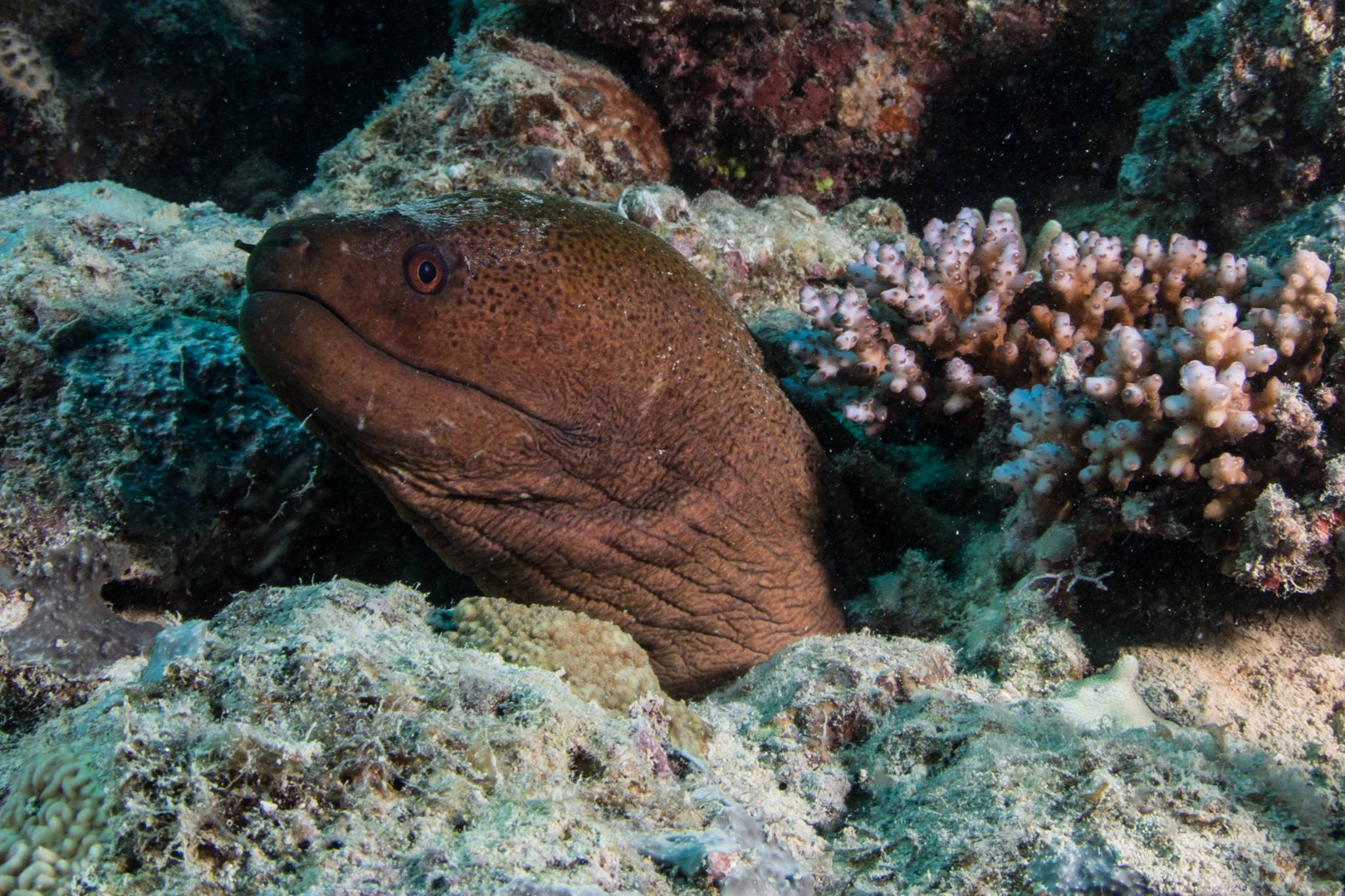
Turtles, reef fish, moray eels and other marine animals may be encountered around Flynn Reef’s bommie environments.
Gordon’s Mooring
Gordon’s Mooring provides another Flynn Reef experience.
The site includes coral bommies, overhangs and swim-throughs, creating more complex terrain for divers to investigate.
Giant clams can be found within the reef environment, while turtles and tropical fish are among the animals associated with this part of Flynn Reef.
As always, individual wildlife sightings vary.
Nothing on a wild reef appears according to a timetable.
And that’s exactly as it should be.
Little Tracey
Little Tracey demonstrates another side of Flynn Reef.
Shallow coral habitat makes parts of the location suitable for snorkelling, while deeper reef terrain provides opportunities for divers.
Crevices and coral formations create shelter for smaller tropical fish.
Turtles and reef sharks may also pass through the area.
The combination of shallow and deeper habitat is one of Flynn Reef’s recurring strengths.
People with very different levels of experience can enter the same reef system and discover different parts of it.
Coral at Flynn Reef
Coral is the foundation of Flynn Reef.
The reef supports different types of hard and soft coral, including branching, plate, table and larger boulder-like growth forms.
Each structure creates habitat.
Tiny fish disappear between branches.
Other species shelter beneath plates and ledges.
Larger animals move between individual coral formations.
Coral also changes the physical environment itself.
Over time, reef growth creates the bommies, walls, channels and other underwater features that make Flynn Reef so interesting to explore.
The reef isn’t a collection of coral sitting on an underwater landscape.
The coral helps create the landscape.
Marine Life at Flynn Reef
Flynn Reef supports an extraordinary community of tropical marine life.
Visitors may encounter butterflyfish, angelfish, parrotfish, wrasse, fusiliers, batfish, coral trout and schools of smaller reef fish.
Moray eels may shelter within reef crevices.
Giant clams live among the coral.
Look carefully and smaller animals such as nudibranchs and other invertebrates may appear.
Turtles, rays and reef sharks may also be encountered.
But there is no checklist.
A wild reef decides what you see.
One visit might be remembered for a turtle.
Another for an enormous school of fish.
And sometimes the highlight is simply watching sunlight move across an extraordinary coral garden.
Sea Turtles at Flynn Reef
Sea turtles are among Flynn Reef’s most memorable potential encounters.
Green and hawksbill turtles inhabit Great Barrier Reef environments and may be seen swimming above coral, feeding around the reef or resting.
If you encounter one, give it room.
Never chase a turtle for a photograph.
And remember that turtles need to surface to breathe, so don’t position yourself in a way that obstructs their path to the surface.
Stay calm and watch.
Often the animal will provide a much better encounter when it doesn’t feel pursued.
Reef Sharks at Flynn Reef
Reef sharks form an important part of healthy coral reef ecosystems.
Small reef sharks may occasionally be seen around Flynn Reef, particularly near reef edges, sandy areas and deeper water.
For first-time snorkellers, seeing a shark can initially sound intimidating.
The experience of observing a reef shark in its natural habitat is often quite different.
Give the animal space and allow it to continue behaving naturally.
Seeing a shark cruising quietly along a coral reef can become one of the day’s most memorable moments.
Giant Clams
Giant clams are another fascinating part of the Flynn Reef ecosystem.
Their brightly patterned mantles can display combinations of blue, green, brown and other colours.
They contain microscopic algae within their tissues that use sunlight for photosynthesis, creating an extraordinary biological relationship between animal and algae.
Look for giant clams embedded among coral formations in shallow, well-lit areas.
Admire them without touching.
They are living parts of the reef, not decorations.
Is Flynn Reef Good for Beginners?
Flynn Reef contains locations suitable for different experience levels.
Shallow coral gardens can provide excellent snorkelling, while some dive sites are appropriate for relatively inexperienced divers when conditions permit.
Other environments, particularly deeper sections or swim-throughs, may require greater experience.
This is why the specific site and conditions on the day matter.
If you’re a first-time snorkeller or aren’t confident in the water, tell the crew before entering.
Use flotation equipment if it makes you more comfortable.
There is no prize for swimming the furthest.
The objective is to become comfortable enough to actually look at the reef.
Flynn Reef for Experienced Divers
Experienced certified divers can appreciate another side of Flynn Reef.
Deeper walls, bommies, overhangs and swim-throughs provide opportunities to explore more complex underwater terrain.
Rather than simply looking for large animals, slow down.
Examine coral walls.
Look beneath overhangs.
Check crevices for smaller marine life.
And occasionally turn away from the reef and look into the blue.
Larger fish and other animals may move along the reef edge without ever entering the coral garden itself.
Where is Flynn Reef?
Flynn Reef lies on the Great Barrier Reef offshore from Cairns in Tropical North Queensland.
It forms part of the collection of offshore reefs accessible on selected Cairns reef trips.
Other reef locations in this broader network include Milln Reef, Thetford Reef and Pellowe Reef, while visitors from Cairns may also experience Norman Reef, Saxon Reef, Hastings Reef, Breaking Patches, Moore Reef and the region’s coral cays.
These names aren’t simply different labels for the same experience.
Each is a distinct reef environment.
That is why learning where your tour actually goes can add considerably to understanding your Great Barrier Reef day.
Flynn Reef or Milln Reef?
Flynn Reef and Milln Reef are both excellent Cairns reef locations, but they have different individual sites and underwater topography.
Milln is particularly associated with locations such as Three Sisters, Whale Bommie and Swimming Pools.
Flynn offers sites such as Tracy’s Bommie, Gordon’s Mooring, Coral Gardens and Little Tracey.
Both provide snorkelling and scuba-diving environments.
Rather than asking which is universally better, ask which location provides the most appropriate conditions and activities on the day you travel.
The Great Barrier Reef changes constantly.
Good reef operators work with those conditions rather than against them.
Flynn Reef or Thetford Reef?
The same applies when comparing Flynn Reef and Thetford Reef.
Both provide beautiful coral habitat and tropical marine life.
Flynn is particularly interesting for its variety of recognised dive locations, bommies, overhangs and swim-throughs.
Thetford offers another extensive coral environment with its own underwater structure.
Experiencing both reinforces one of the most important lessons about the Great Barrier Reef:
individual reefs really are different.
When is the Best Time to Visit Flynn Reef?
The Great Barrier Reef can be experienced from Cairns throughout the year.
There is no single month when Flynn Reef is guaranteed to have perfect conditions.
Wind, tides, currents, recent weather and cloud cover can all influence surface conditions and underwater visibility.
Conditions offshore can also be quite different from those in Cairns.
This is one reason operators with access to several reef sites can be valuable.
Experienced skippers can consider conditions when determining where to operate.
If Flynn Reef specifically is important to you, check the tour’s listed reef locations while understanding that final site selection may depend on conditions.
Protecting Flynn Reef
Flynn Reef is a living ecosystem.
Treat it accordingly.
Never stand on coral or deliberately touch it.
Maintain good buoyancy if scuba diving.
Keep fins and equipment away from coral formations.
Give turtles, sharks, rays and other animals room to move naturally.
Don’t chase wildlife for photographs.
And never remove shells, coral or marine organisms.
The best Great Barrier Reef visitor leaves almost nothing behind.
No rubbish.
No damaged coral.
No disturbed animals.
Only bubbles, memories and photographs.
Experience Flynn Reef from Cairns
Flynn Reef can be experienced on selected Great Barrier Reef tours from Cairns, including itineraries offering snorkelling and scuba diving.
Operators with access to multiple reefs may select locations according to their itinerary, weather, currents and conditions.
If Flynn Reef specifically is important to you, check the individual tour details before booking.
And if Flynn is where your day takes you, don’t rush through it.
Float above the coral gardens.
Look inside the crevices.
Watch schools of fish moving through shafts of sunlight.
If you’re diving, look back towards the entrance of a swim-through and see the blue Coral Sea framed by the living reef around you.
Because Flynn Reef isn’t simply somewhere to snorkel or dive.
It is a landscape built by life, and when you enter the water, for a little while, you become a visitor inside it.

Reviews
There are no reviews yet