







Michaelmas Cay is a remarkable coral cay on the Great Barrier Reef, approximately 45 kilometres north-east of Cairns, where a tiny vegetated island, an important seabird breeding sanctuary and a beautiful coral reef ecosystem come together in one extraordinary place.
Unlike many Outer Great Barrier Reef destinations visited from Cairns, Michaelmas Cay actually rises above the ocean.
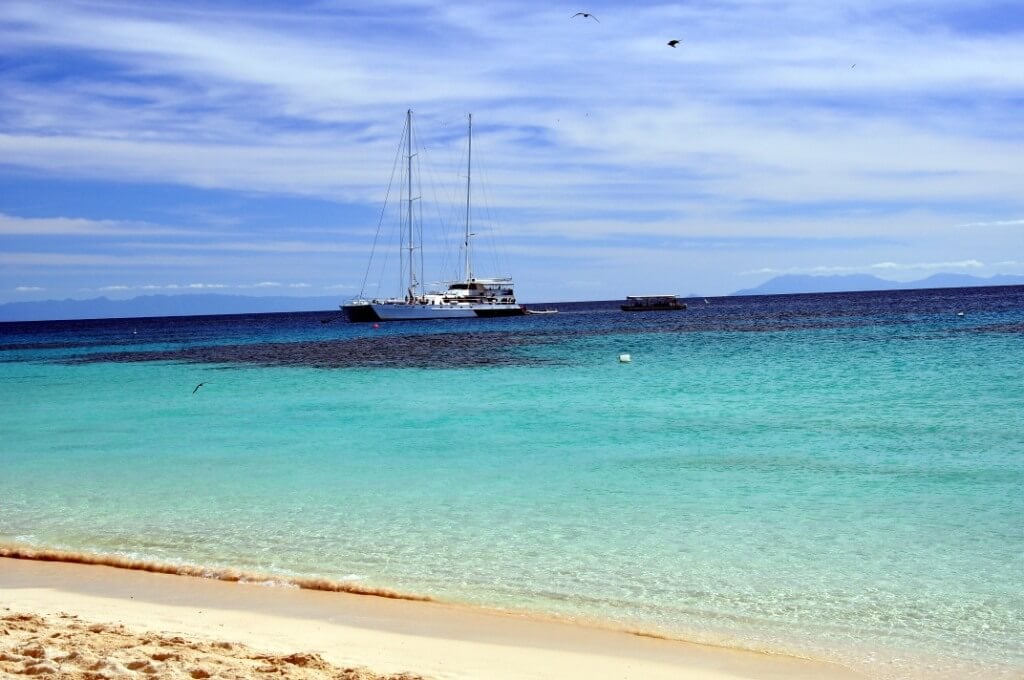
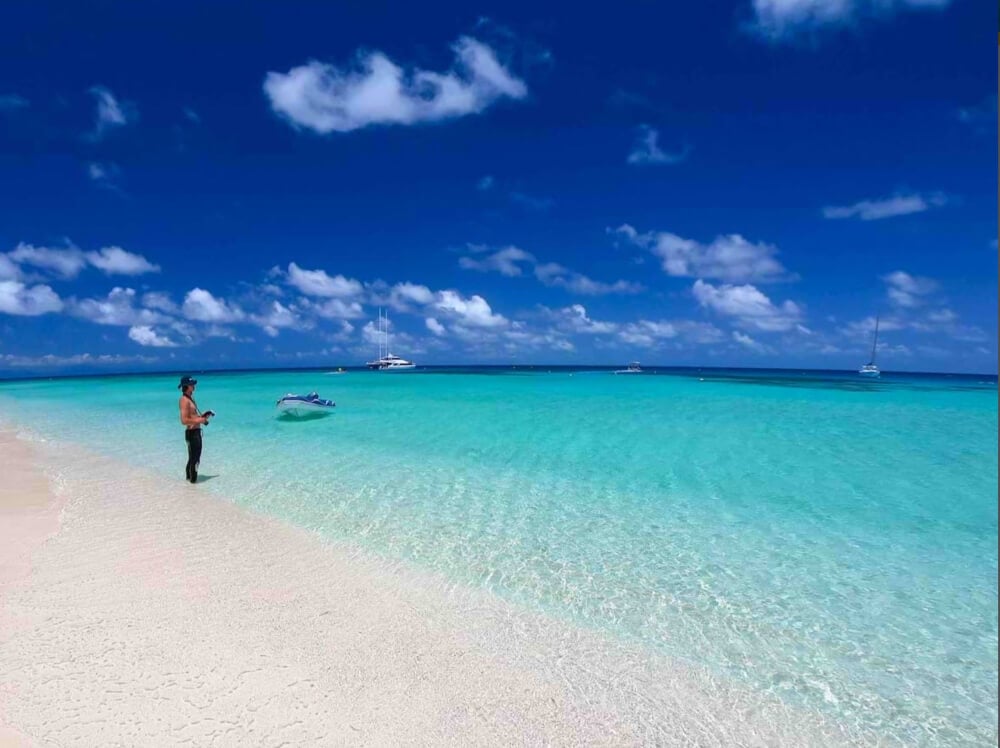
Its white sand and low vegetation sit at the western end of Michaelmas Reef, surrounded by shallow turquoise water and coral habitat.
Below the surface are tropical fish, giant clams, sea turtles and coral gardens.
Above it, thousands of seabirds may gather to nest, rest and raise their young.
Michaelmas Cay therefore offers something unusual.
You don’t experience only what is beneath the water.
You can see how the reef, sand, plants, birds and ocean have created one interconnected ecosystem.
What is Michaelmas Cay?
Michaelmas Cay is a vegetated coral cay formed from reef material accumulated over time.
Broken coral, shells and the remains of calcareous algae were transported and deposited by currents and waves. Vegetation subsequently helped stabilise the cay, while beach rock contributed further stability.
Today, Michaelmas Cay is approximately 360 metres long and 50 metres wide, covers about 1.8 hectares and rises around 3.5 metres above sea level. It lies on the western tip of Michaelmas Reef, approximately 45 kilometres north-east of Cairns and 17 kilometres north of Green Island.
Those dimensions sound small.
From the air, it looks small.
But ecologically, Michaelmas Cay is enormously important.
A Coral Cay Built by the Reef
Michaelmas Cay provides a wonderful opportunity to understand how coral reef systems can create land.
A coral cay doesn’t begin as an island in the conventional sense.
Fragments of coral, shells and other calcium-rich reef material are broken down and transported by waves and currents.
Under suitable conditions, this material accumulates.
More arrives.
The deposit begins to stabilise.
Seeds can arrive by waves and birds.
Plants establish themselves.
Their roots help hold the surface together.
Over time, what began beneath the ocean becomes a piece of land visible above it.
At Michaelmas Cay, the relationship becomes beautifully clear:
the reef helped create the island, and the island now provides habitat for life above the reef.
Michaelmas Cay Seabird Sanctuary
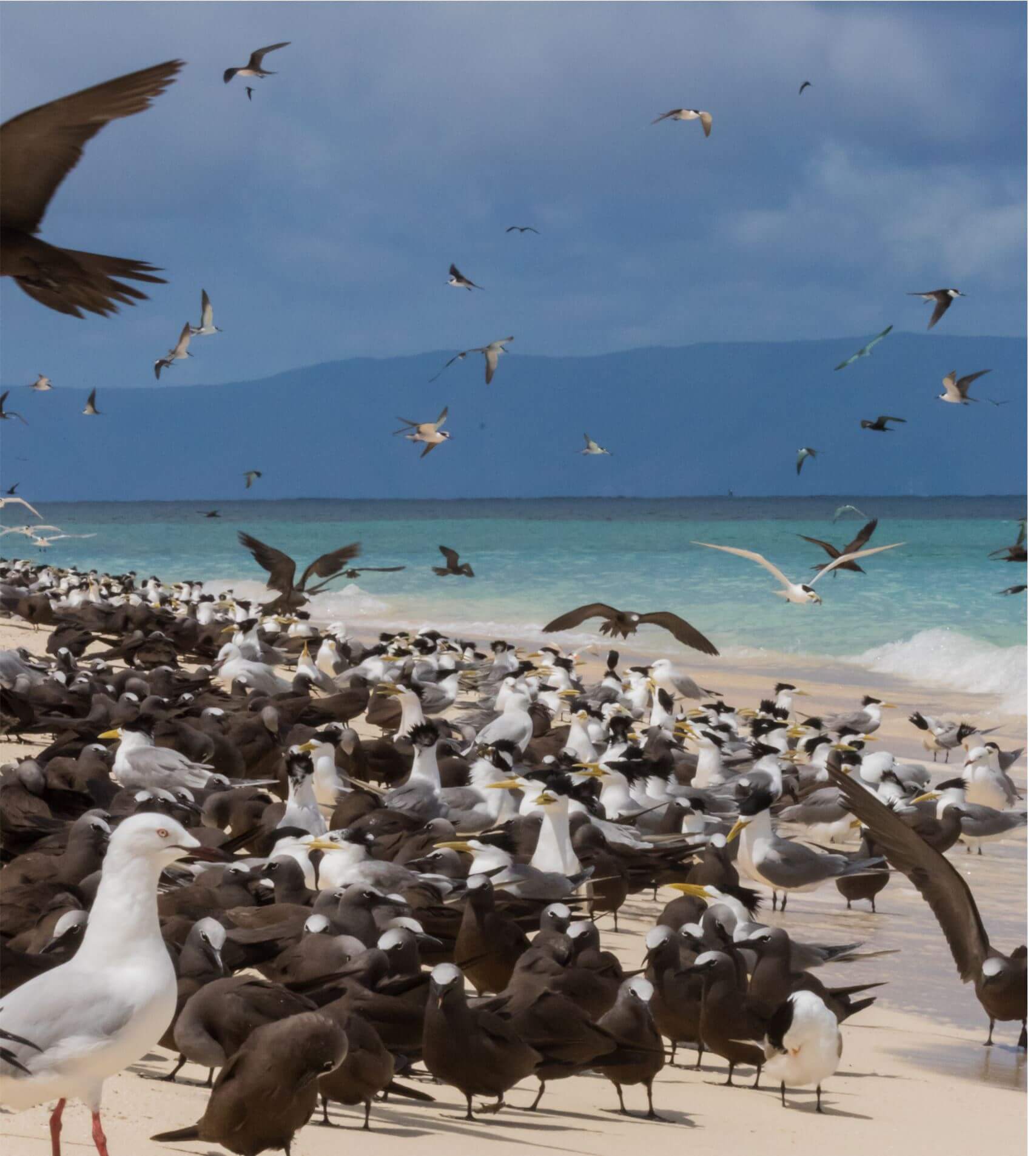
Michaelmas Cay is one of the most important seabird breeding areas on the Great Barrier Reef.
Seabirds nest here throughout the year, with Queensland Parks noting that up to 20,000 breeding pairs have been recorded. Different species reach breeding peaks at different times of year.
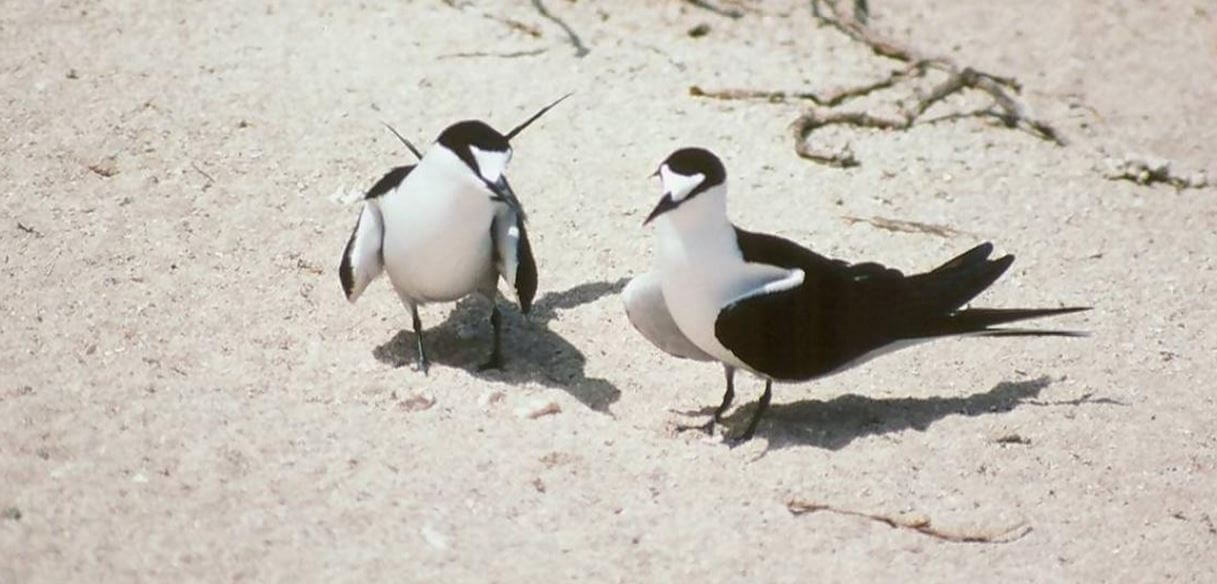
Ocean Spirit reports at least 23 seabird species associated with the cay.
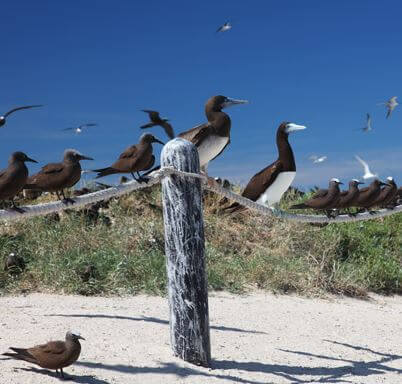
Among the birds visitors may observe are:
-
- Sooty terns
- Common or brown noddies
- Crested terns
- Lesser crested terns
- Black-naped terns
- Black noddies
- Brown boobies
- Greater frigatebirds
- Caspian terns
- Silver gulls
Some may be nesting.
Others may be resting, feeding or returning from the ocean.
This makes Michaelmas Cay very different from a conventional beach destination.
The beach belongs to the birds first.
Why Access to Michaelmas Cay is Restricted
Visitor access is deliberately limited to protect the seabird colony.
Access is permitted only within the designated roped beach area between 9:30 am and 3:00 pm. Entry to the national park above the high-water mark is prohibited.
These restrictions are important.
Nesting seabirds can be easily disturbed.
If adults are frightened away from nests, eggs and chicks may be exposed to predators or extreme tropical heat.
Visitors should remain within the permitted area and avoid disturbing nesting or roosting birds.
Kites and beach umbrellas are prohibited because they can also disturb the colony.
Michaelmas Cay isn’t somewhere we need to conquer or explore every metre of.
Sometimes protecting a special place means accepting that some of it should remain beyond our footsteps.
Snorkelling at Michaelmas Cay
Michaelmas Cay offers a particularly appealing way to experience the Great Barrier Reef:
you can snorkel directly from the beach.
The surrounding shallow water provides access to coral habitat only a short distance from shore, and current Michaelmas Cay trips describe calm, shallow snorkelling conditions suitable for beginners as well as experienced swimmers.
Walk into the water.
Put your face beneath the surface.
And the landscape changes.
Tropical fish move between coral formations.
Giant clams sit embedded within the reef.
Sea cucumbers occupy the seabed.
Schools of fish move through the shallows.
And, with some luck, a sea turtle may appear.
For someone experiencing the Great Barrier Reef for the first time, there is something wonderfully simple about it.
The journey from beach to reef can be measured in footsteps.
Coral Gardens
Michaelmas Reef supports hard and soft coral communities around the cay.
In shallow water, sunlight reaches the reef particularly effectively.
That light supports the microscopic algae living within coral tissues and helps illuminate the extraordinary underwater landscape for snorkellers.
Look beyond colour.
Notice structure.
Branching coral creates shelter.
Plate corals extend horizontally.
Large coral colonies provide habitat for fish and smaller organisms.
Small spaces between corals become homes.
The coral isn’t simply what visitors have come to photograph.
It is what makes much of the surrounding community possible.
Giant Clams
Michaelmas Reef is particularly known for its giant clams.
These extraordinary molluscs can display beautifully patterned mantles in combinations of blue, green, brown and other colours.
Their appearance is remarkable enough.
Their biology is even better.
Giant clams contain microscopic algae within their tissues. The algae photosynthesise using sunlight and contribute nutrients to their host.
The relationship is another example of something you begin to understand when looking closely at the Great Barrier Reef:
Very little here exists completely independently.
Coral depends on relationships.
Clams depend on relationships.
Fish depend on habitat created by other organisms.
Connection is one of the fundamental building blocks of a reef.
Sea Turtles
Green sea turtles are among the marine animals found around Michaelmas Cay, and they occasionally nest on the cay itself.
Seeing a turtle while snorkelling can become the moment people remember long after their reef trip is over.
If you’re fortunate enough to encounter one, give it space.
Don’t chase it.
Don’t touch it.
And never position yourself between a turtle and the surface.
Sea turtles breathe air and must always be able to surface freely.
Stay quiet and observe.
The best wildlife encounter is one where the animal can continue behaving as though you weren’t there.
Tropical Fish
Hundreds of species of tropical reef fish are associated with the waters around Michaelmas Cay, with larger species such as humphead Maori wrasse also recorded.
Visitors may encounter parrotfish and numerous smaller reef species, while giant trevally and blacktip reef sharks are also among the animals reported from the surrounding reef.
But don’t turn your snorkel into a checklist.
Wildlife doesn’t work that way.
One day might produce an unforgettable turtle encounter.
Another could be dominated by huge schools of fish.
On another, the most interesting discovery might be a tiny animal living inside a single coral formation.
A wild reef decides what it shows you.
Reef Sharks
Small reef sharks may occasionally be seen in the waters around Michaelmas Cay, including blacktip reef sharks.
For some visitors, the idea of seeing a shark creates nervousness before entering the water.
Seeing one in its natural environment often changes that perspective.
A reef shark moving quietly through clear tropical water is simply another member of the ecosystem.
Give it space.
Don’t pursue it.
Watch it move naturally through its home.
We are the visitors here.
Scuba Diving at Michaelmas Cay
Michaelmas Cay isn’t only for snorkellers.
Introductory scuba diving is currently offered at the cay, with its shallow protected environment used for skills practice before participants explore the surrounding reef with an instructor.
That makes Michaelmas particularly interesting for someone considering their first scuba dive.
Snorkelling allows you to look down into the reef.
Scuba changes the perspective.
You descend into the environment you were previously observing from above.
Coral becomes larger.
Fish can move around you.
And suddenly you understand just how three-dimensional a reef really is.
Michaelmas Cay for First-Time Snorkellers
The beach-access snorkelling and shallow water around Michaelmas Cay can make it particularly attractive to first-time snorkellers and families.
If you’re nervous, don’t pretend otherwise.
Tell the crew.
Use a flotation vest.
Practise breathing through your snorkel somewhere comfortable.
Then move gradually towards the coral.
You don’t need to swim a kilometre.
You don’t need to dive underwater.
And you don’t need to keep up with anybody else.
The objective is to become comfortable enough to stop thinking about snorkelling and start looking at the reef.
Michaelmas Cay for Non-Swimmers
Michaelmas Cay can also be experienced without snorkelling or scuba diving.
Current day trips include semi-submersible or glass-bottom reef viewing, allowing visitors to observe coral and marine life while remaining dry.
And then there are the birds.
For someone interested in wildlife, simply spending time within the permitted beach area observing thousands of seabirds can be an extraordinary experience in its own right.
This is an important point.
There is no single correct way to experience the Great Barrier Reef.
Some people swim above it.
Some dive into it.
Some look through glass.
Some watch the wildlife above the water.
Every perspective reveals a different part of the same ecosystem.
Michaelmas Cay or an Outer Reef Site?
Michaelmas Cay offers a distinctly different experience from reefs such as Norman Reef, Saxon Reef, Flynn Reef, Milln Reef, Thetford Reef or Hastings Reef.
Those locations are primarily underwater reef environments.
Michaelmas adds something else:
land.
A beach.
Vegetation.
Thousands of seabirds.
And the opportunity to snorkel directly from a natural coral cay.
Neither experience is inherently better.
They answer different questions.
If you want to explore walls, bommies and deeper diving terrain, an Outer Reef site may be more appropriate.
If the combination of beach snorkelling, coral, marine life and an internationally significant seabird habitat appeals to you, Michaelmas Cay has an identity all its own.
Michaelmas Cay or Upolu Cay?
Michaelmas Cay and Upolu Cay are both coral cays accessible from Cairns, but they should not be treated as interchangeable.
Michaelmas is the larger cay and supports established vegetation and an exceptionally important seabird breeding colony.
Upolu is a much smaller unvegetated sand cay. Queensland’s management plan describes Michaelmas as approximately 360 metres by 50 metres and 1.8 hectares, while identifying Upolu as the smaller unvegetated cay.
Seeing both helps explain that even coral cays within the same region can develop very differently.
Michaelmas Cay or Vlasoff Cay?
Michaelmas Cay is also very different from Vlasoff Cay.
Vlasoff is best understood as a small sand cay and spectacular aerial Great Barrier Reef experience.
Michaelmas is vegetated and ecologically significant as a major seabird breeding site.
If we think only in terms of white sand and turquoise water, they can appear similar.
Once we understand their ecology, they’re very different places.
That is precisely why these individual reef and cay pages matter.
Where is Michaelmas Cay?
Michaelmas Cay lies on the western tip of Michaelmas Reef, approximately 45 kilometres north-east of Cairns and 17 kilometres north of Green Island.
It forms part of the Great Barrier Reef World Heritage Area and Great Barrier Reef Marine Park.
Michaelmas and neighbouring Upolu Cay are protected as Michaelmas and Upolu Cays National Park.
From Cairns, the journey itself helps reveal the scale of the reef environment.
The coastline disappears behind you.
Open Coral Sea surrounds the vessel.
Then a tiny strip of pale sand appears against the blue.
Michaelmas Cay looks almost impossibly small from a distance.
What it supports is anything but.
Cultural Significance
Michaelmas Cay also has cultural significance to the Gungandji, Mandingalbay-Yidinji and Yirriganydji peoples, according to current visitor information for the cay.
That is important context.
The Great Barrier Reef is not simply a natural attraction or tourism destination.
It is also part of a living cultural landscape with connections extending far beyond the relatively short history of modern reef tourism.
When is the Best Time to Visit Michaelmas Cay?
Michaelmas Cay can be visited throughout the year, but the experience is never exactly the same.
Weather, wind, tides and sea conditions affect the journey and water visibility.
The bird community changes too.
Seabirds breed throughout the year, but different species have different seasonal peaks. Queensland Parks notes that sooty tern numbers peak in winter, while common noddies and crested and lesser crested terns peak during summer.
That means there isn’t one single “Michaelmas Cay season”.
The cay is alive throughout the year.
What changes is the chapter you happen to arrive for.
Protecting Michaelmas Cay
Michaelmas Cay requires particularly careful behaviour because visitors are entering both a coral reef ecosystem and an important seabird breeding sanctuary.
Remain inside the designated visitor area.
Don’t enter the protected nesting area.
Never disturb birds, nests, chicks or eggs.
Don’t stand on or deliberately touch coral.
Don’t collect shells, coral, clams or other marine life.
Fishing and collecting are prohibited within the surrounding Green Zone.
These restrictions aren’t obstacles to enjoying Michaelmas Cay.
They are part of the reason there is still something extraordinary here to enjoy.
Sometimes loving a place means accepting where we should not go.
Experience Michaelmas Cay from Cairns
Michaelmas Cay can be experienced on a full-day Great Barrier Reef trip from Cairns, with Ocean Spirit currently operating to the cay and spending approximately four hours at the reef.
Current activities include beach-access snorkelling, semi-submersible or glass-bottom reef viewing and marine-biologist interpretation, with guided snorkelling and introductory scuba diving also available as optional experiences.
But Michaelmas Cay is bigger than its activity list.
Walk onto the permitted beach and look towards the birds.
Then turn towards the water.
Put on a mask and look beneath the surface.
Above you is a seabird sanctuary.
Below you is a coral reef.
Between them is a tiny island assembled from fragments of that reef and stabilised over time by the very natural processes continuing around you.
Michaelmas Cay shows us something beautiful about the Great Barrier Reef: life doesn’t simply occupy this landscape, life helps create it.

Reviews
There are no reviews yet