


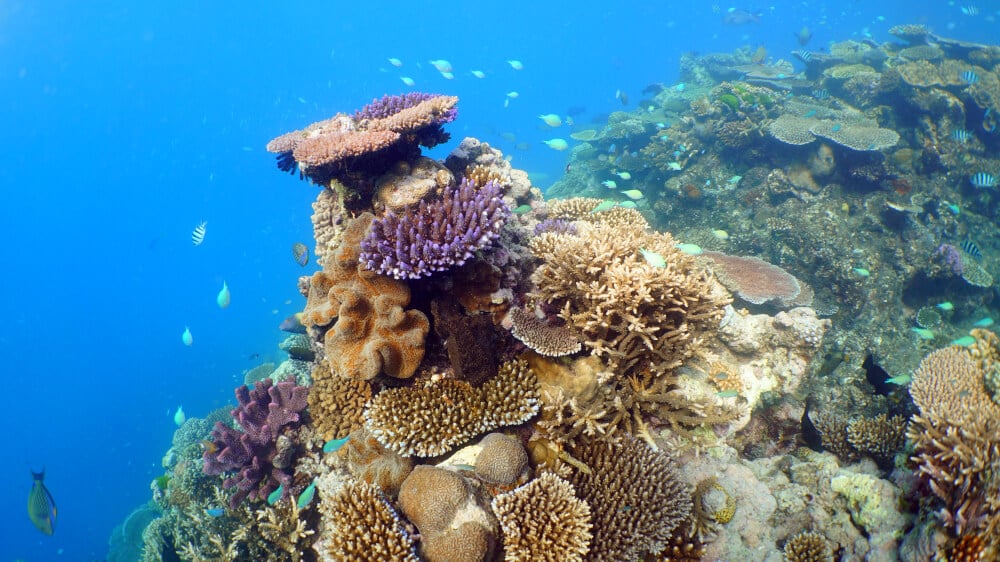


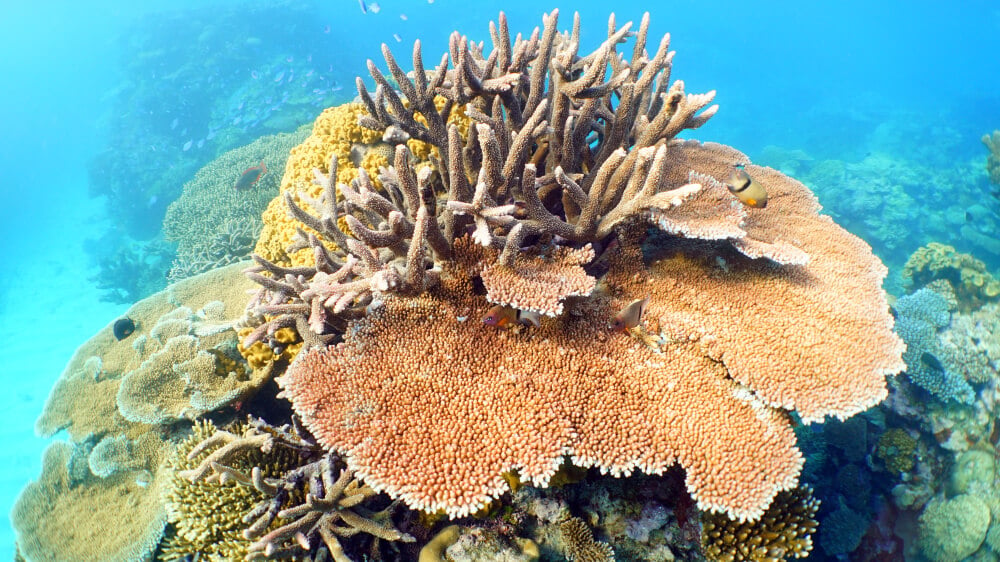


Milln Reef is one of the outstanding Great Barrier Reef locations accessible from Cairns, offering beautiful coral gardens, dramatic underwater landscapes and an impressive variety of marine life.
This is a reef that rewards both snorkellers and scuba divers.
Close to the surface, shallow coral gardens and reef walls allow snorkellers to look down into a world of colourful fish and living coral. Below, scuba divers can explore walls, pinnacles, bommies, sandy areas and swim-throughs.
Milln Reef also contains several individually recognised sites, including Three Sisters, Whale Bommie, Petaj Mooring and Swimming Pools, each offering a different way to experience the reef.
It means a visit to Milln Reef isn’t simply about saying you have been to the Great Barrier Reef.
It is about discovering one particular part of an enormous living ecosystem.
What Makes Milln Reef Special?
Milln Reef’s greatest strength is its variety.
Different sections of the reef provide markedly different underwater environments. There are shallow reef flats suitable for snorkelling, coral-covered walls, isolated bommies, pinnacles, sandy areas and deeper sites for experienced divers.
Recognised diving information describes typical Milln Reef sites as having mild currents, depths ranging approximately from 5 to 30 metres and visibility commonly around 15 to 20 metres, although actual conditions naturally vary from day to day.
This variety allows the reef to support an equally diverse marine community.
Turtles and whitetip reef sharks are associated with some Milln Reef sites, while schools of sweetlips, barracuda and other tropical fish can be found elsewhere. Smaller animals such as nudibranchs reward visitors who take the time to look closely.
Snorkelling at Milln Reef
You don’t need to scuba dive to appreciate Milln Reef.
Some locations provide shallow coral environments where snorkellers can explore the reef from the surface.
At Three Sisters, the coral bommies create both deeper diving environments and shallow areas accessible to snorkellers. Another location known as The Whale sits close to the reef edge and can also be snorkelled.
This is where slowing down becomes important.
Rather than swimming continuously, stop above a coral garden and watch.
Small fish move in and out of the coral. Larger schools may pass across the reef. A turtle might appear above a bommie or a reef shark may cruise quietly through deeper water.
Wildlife encounters are never guaranteed, but that unpredictability is part of experiencing a natural reef.
Scuba Diving at Milln Reef
Milln Reef is particularly well known for scuba diving.
The reef offers wall dives, pinnacles, bommies and swim-throughs, with sites suitable for different experience levels. Some locations are relatively shallow, while others descend beyond 20 metres.
For divers, this means successive dives at Milln Reef can be completely different.
One dive might involve exploring around a coral bommie.
The next could follow a reef wall.
Another might involve swim-throughs, pinnacles or watching large schools of fish moving through open water.
Milln Reef is also recognised for night diving, when nocturnal reef animals emerge and familiar daytime locations take on an entirely different character.
Three Sisters
Three Sisters is one of Milln Reef’s best-known locations.
As its name suggests, the site consists of three substantial coral bommies or pinnacles, each providing a different underwater environment.
The formations range into deeper water, while shallower sections allow snorkellers to experience coral and schooling fish from above. The site is associated with abundant fish life, turtles and reef sharks, while divers can investigate walls, crevices and the spaces surrounding the bommies.
Three Sisters demonstrates why individual reef sites matter.
The Great Barrier Reef isn’t one uniform underwater landscape. Even within Milln Reef, the terrain can change dramatically from one location to another.
Whale Bommie
Whale Bommie, sometimes simply called The Whale, is another distinctive Milln Reef site.
It is a large isolated bommie close to the reef edge.
The name comes from an unusual natural effect. At low tide, waves breaking across the shallow top can produce a plume of water reminiscent of a whale’s blow.
Below the surface, the site extends into considerably deeper water.
Whale Bommie offers wall diving and is known for soft corals and gorgonian sea fans. Turtles and whitetip reef sharks are among the marine animals associated with the site, and after dark divers may encounter reef crabs and painted lobsters.
Petaj Mooring
Petaj Mooring provides yet another Milln Reef environment.
The site is known for wall diving and swim-throughs, with fan corals and staghorn coral habitat extending across parts of the reef.
Resident turtles and whitetip reef sharks are regularly associated with Petaj, while other marine life can include barracuda, batfish, angelfish and numerous tropical reef species.
Of course, “resident” doesn’t mean guaranteed.
These are wild animals living freely within the Great Barrier Reef ecosystem.
Swimming Pools
Milln Reef also has sites known as Swimming Pools I and Swimming Pools II.
These areas feature coral outcrops and bommies surrounded by sandy sections, creating another distinct habitat.
Schools of diagonally banded sweetlips are particularly associated with the Swimming Pools, while divers can also look for nudibranchs among the reef’s smaller inhabitants.
These smaller creatures are worth seeking out.
The Great Barrier Reef’s spectacular turtles, sharks and large schools of fish understandably attract attention, but much of its biodiversity exists on a completely different scale.
Coral at Milln Reef
Milln Reef’s physical structure creates habitat for an enormous community of marine organisms.
Hard coral formations build the underlying reef environment, while areas of soft coral and gorgonian sea fans add another dimension to deeper sections and walls.
Bommies rise from deeper water.
Coral covers reef walls.
Sandy areas separate individual formations.
Together these environments provide feeding grounds, shelter and nursery habitat for reef animals.
For snorkellers, coral gardens can be appreciated from above.
For scuba divers, the reef becomes three-dimensional. You can descend beside a wall, move around a bommie or look beneath an overhang and discover an entirely different community of marine life.
Marine Life at Milln Reef
Milln Reef supports an impressive variety of Great Barrier Reef marine life.
Depending on the location, season and conditions, visitors may encounter sea turtles, whitetip reef sharks, barracuda, sweetlips, parrotfish, batfish, angelfish and schools of other tropical reef fish.
Look closer and you may discover nudibranchs, reef crabs and other smaller animals living among the coral.
Night diving changes the experience again. Painted lobsters and reef crabs emerge, while parrotfish may be found sleeping within protective mucus cocoons.
There is no checklist that every visitor will complete.
The animals decide what you see.
That’s part of what makes every Great Barrier Reef visit different.
Sea Turtles at Milln Reef
Your photograph is particularly appropriate for this page because turtles are genuinely associated with Milln Reef.
Petaj Mooring is known for resident turtles, while turtles are also commonly reported around Three Sisters and Whale Bommie.
If you’re fortunate enough to encounter one, give it space.
Don’t chase it for a photograph or block its route to the surface. A turtle needs to surface to breathe and should always be allowed to move naturally.
Often, the best encounter comes from doing very little.
Stay still and watch.
Reef Sharks at Milln Reef
Whitetip reef sharks are another important part of the Milln Reef ecosystem.
They may be seen resting on sandy areas or moving around the reef, particularly at locations such as Petaj Mooring and Whale Bommie.
For many first-time Great Barrier Reef visitors, seeing a shark creates apprehension.
Underwater, the experience is often quite different.
Watching a reef shark moving naturally through its own environment can become one of the highlights of a snorkel or dive.
As with all wildlife, give it space and allow it to determine the encounter.
Is Milln Reef Good for Beginners?
Milln Reef has sites suitable for a range of experience levels.
Current dive-site information generally rates Milln Reef novice to intermediate, with mild currents at the sites profiled, although conditions and individual locations vary.
For snorkellers and first-time visitors, the particular site selected matters more than the name of the overall reef.
Crew choose locations according to conditions, activities and the abilities of their passengers.
If you aren’t a confident swimmer, tell the crew before entering the water and use the flotation equipment provided.
Being comfortable allows you to stop concentrating on swimming and start looking at the extraordinary environment beneath you.
Night Diving at Milln Reef
For certified divers travelling on an appropriate itinerary, night diving is one of Milln Reef’s special experiences.
As daylight disappears, the behaviour of the reef changes.
Animals that were hidden during the day emerge from crevices. Reef crabs and painted lobsters become active, while sleeping turtles and parrotfish may be encountered around the reef.
The same coral formations seen during daylight can feel completely different under torchlight.
It is a reminder that the Great Barrier Reef never really goes to sleep.
Where is Milln Reef?
Milln Reef is located offshore from Cairns within the Great Barrier Reef Marine Park.
The Great Barrier Reef Marine Park Authority identifies Milln Reef as a managed tourism location within the Cairns/Cooktown management area. It is classified as a moderate-use location, with moorings and anchoring arrangements designed to manage vessel access and help protect the reef environment.
Milln Reef sits among a broader collection of Great Barrier Reef locations accessible on trips from Cairns, including Flynn Reef, Thetford Reef and Pellowe Reef.
Each has different underwater terrain and marine habitats.
That is exactly why we are documenting them individually.
Protecting Milln Reef
Milln Reef is not an attraction constructed for visitors.
It is a living ecosystem that we are fortunate enough to experience.
Never stand on or deliberately touch coral. Give turtles, sharks and other wildlife room to behave naturally. Don’t remove shells, coral or marine life from the reef.
Listen to the crew’s environmental briefing and use established moorings and access points as directed.
The Great Barrier Reef Marine Park Authority specifically manages vessel use and moorings at Milln Reef, including restrictions around private moorings and motorised water sports.
Responsible tourism means enjoying the reef without diminishing it.
Experience Milln Reef from Cairns
Milln Reef can be experienced on selected Great Barrier Reef tours departing from Cairns, including itineraries offering snorkelling and scuba diving.
Not every tour visits Milln Reef, and operators with access to several reefs may choose their location according to itinerary, permits, weather and conditions on the day.
If visiting Milln Reef specifically matters to you, check the individual tour’s reef locations before booking.
And if you do arrive here, don’t rush.
Look across the coral gardens.
Watch the schools of fish moving around the bommies.
Look beneath you for a turtle or a whitetip reef shark resting on the sand.
Whether you experience Milln Reef floating quietly at the surface or descending beneath it with scuba equipment, you are visiting just one small part of an enormous interconnected living system.
That is what makes exploring the Great Barrier Reef from Cairns so remarkable, every reef has its own story.

Reviews
There are no reviews yet