
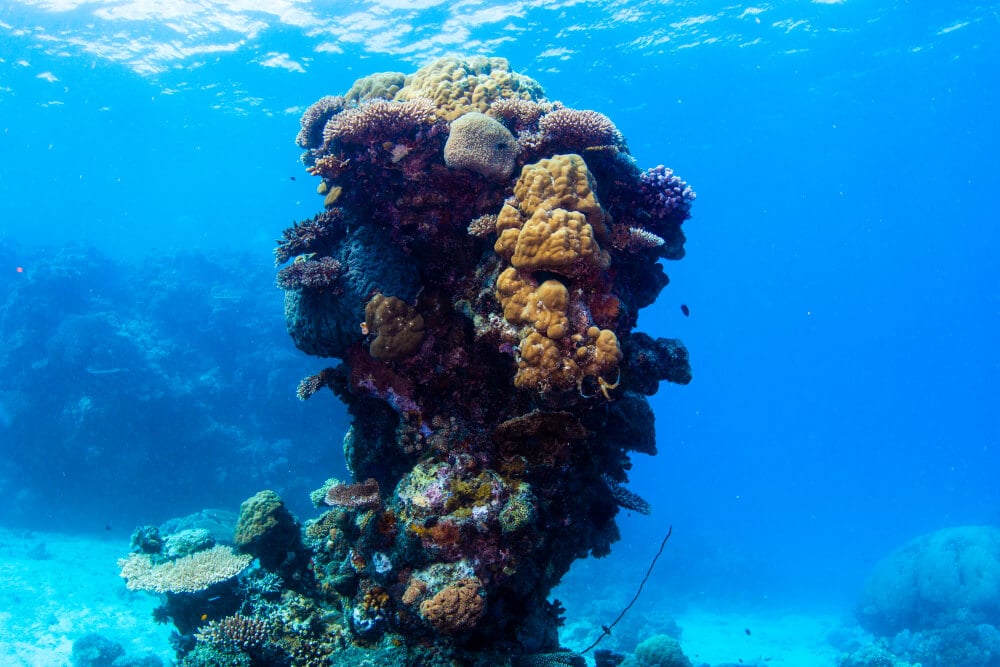

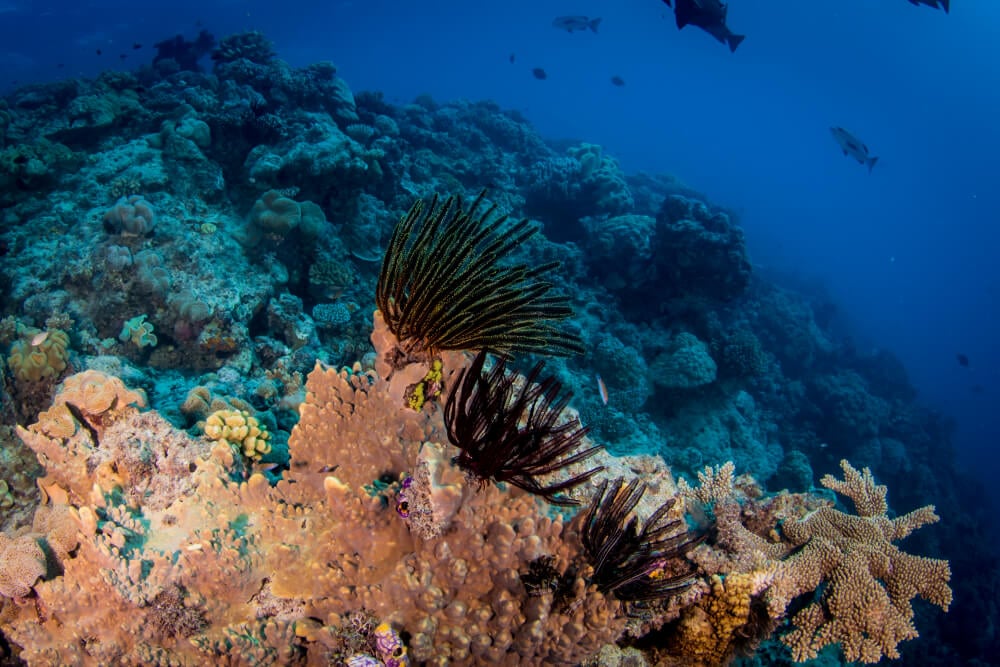
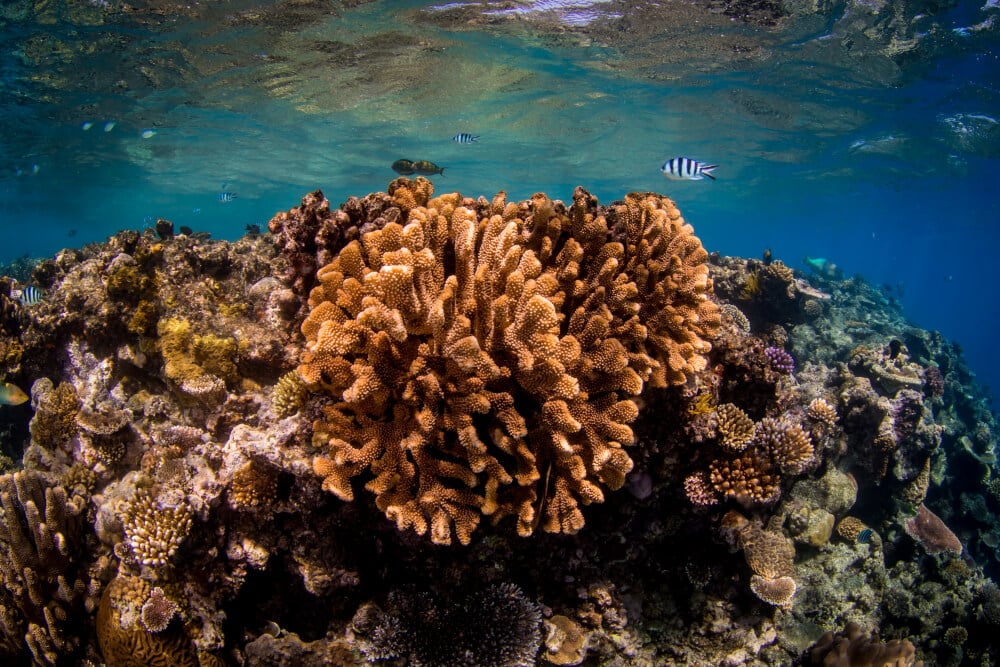
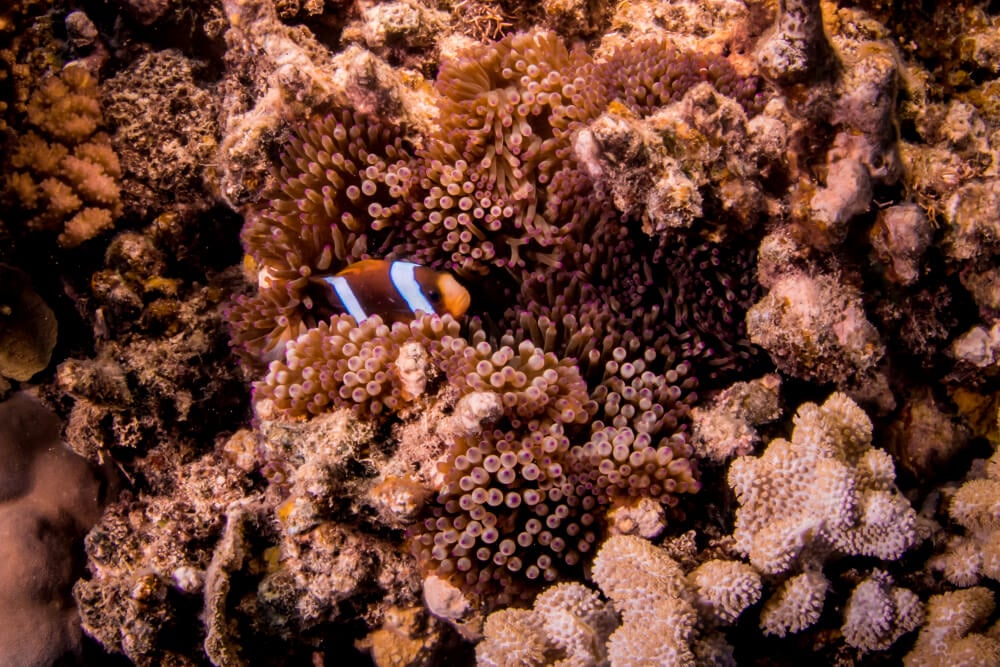


Saxon Reef is a beautiful Outer Great Barrier Reef location accessible from Cairns, offering shallow coral gardens, colourful tropical fish and varied underwater terrain for both snorkelling and scuba diving.
Situated between Norman Reef and Hastings Reef, Saxon Reef is a relatively compact reef system where coral bommies, sandy areas, reef walls and deeper sections create a range of different marine habitats.
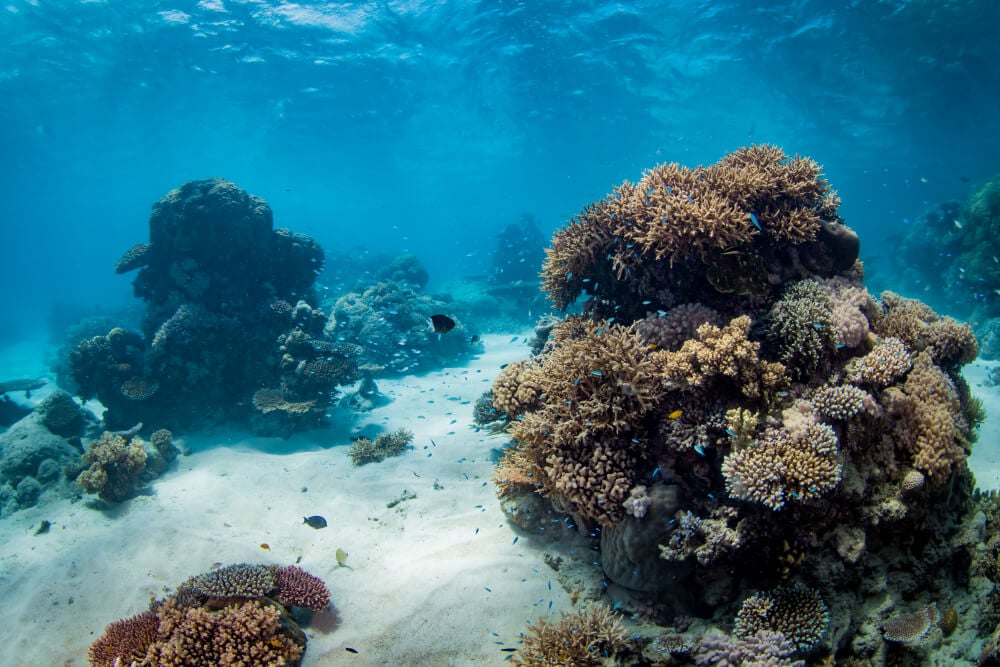
For snorkellers, shallow coral brings the reef within easy view from the surface.
For scuba divers, descending beneath the water reveals another landscape — coral-covered bommies, reef edges, sandy areas and deeper environments where different marine animals can be found.
Saxon may be smaller than some neighbouring reef systems, but that doesn’t make it less interesting.
On the Great Barrier Reef, size doesn’t determine diversity.
What Makes Saxon Reef Special?
One of Saxon Reef’s strengths is the variety packed into a relatively concentrated reef environment.
Shallow coral areas provide habitat for tropical reef fish and allow snorkellers to experience the reef from above.
Move towards the edges and the underwater landscape changes.
Coral formations rise from sandy areas. Bommies create isolated centres of marine activity. Reef walls descend towards deeper water, where divers can explore a completely different habitat.
This mixture makes Saxon Reef suitable for different ways of experiencing the Great Barrier Reef.
You can float quietly above it.
Or descend beneath the surface and become part of the underwater landscape for a while.
Snorkelling at Saxon Reef
Saxon Reef can provide excellent Great Barrier Reef snorkelling when conditions are suitable.
Where coral rises close to the surface, snorkellers can look directly down into coral gardens filled with tropical fish.
Sunlight is particularly important in these shallower environments.
It penetrates through the water and illuminates the coral, revealing colours and textures that become progressively less visible with depth.
Don’t feel that you need to swim continuously.
Stop above a coral formation.
Float.
Watch.
At first you may notice the larger fish. Then smaller animals begin to appear.
Butterflyfish move between coral heads. Damselfish hover close to shelter. Parrotfish graze across the reef.
Sometimes the best way to experience Saxon Reef is simply to stay still and let the reef come to you.
Scuba Diving at Saxon Reef
Scuba diving reveals another side of Saxon Reef.
Beneath the shallow coral gardens, divers can explore bommies, walls, sandy areas and deeper reef terrain.
The change in depth also changes the marine community.
Different fish occupy different parts of the reef, while sandy sections provide habitat for animals that may not spend much time among dense coral.
Divers can move slowly around coral structures, examine crevices and look beneath ledges for smaller marine life.
Occasionally, it is worth turning away from the reef entirely.
Look into the blue.
Larger fish, rays or other animals may move along the reef edge without entering the coral garden itself.
Saxon Reef Dive Sites
Saxon Reef contains several recognised mooring and dive locations, including sites known as Twin Peaks, Turtle Bommie, Clipper and the Mooring.
Each explores a different part of the broader Saxon Reef environment.
That distinction is important.
When someone says they have dived Saxon Reef, they haven’t necessarily seen everything Saxon has to offer.
Individual sites can differ in depth, coral structure, exposure and marine life.
It is another reason why repeat visits to the Great Barrier Reef can feel completely different.
Twin Peaks
Twin Peaks is one of the recognised locations associated with Saxon Reef.
As the name suggests, coral formations create prominent underwater structures that provide habitat for reef fish and other marine life.
Bommies are particularly interesting because they concentrate activity.
Small fish shelter close to the coral.
Larger fish move around the perimeter.
Predators may patrol nearby.
And divers can circle the formation, observing how the habitat changes from one side to another.
A single coral bommie can support an extraordinary amount of life.
Turtle Bommie
A Saxon Reef location known as Turtle Bommie gives us another clue about the animals associated with these reef environments.
Sea turtles may be encountered around Saxon Reef, swimming above coral, feeding or resting within suitable habitat.
Of course, the name doesn’t mean a turtle will be waiting when you arrive.
This is a wild reef.
If you are fortunate enough to encounter one, give it space.
Never chase a turtle for a photograph and don’t obstruct its route to the surface. Turtles need to breathe air and must always be free to surface.
Often, staying still provides the best encounter.
Coral at Saxon Reef
Coral creates the physical foundation of Saxon Reef.
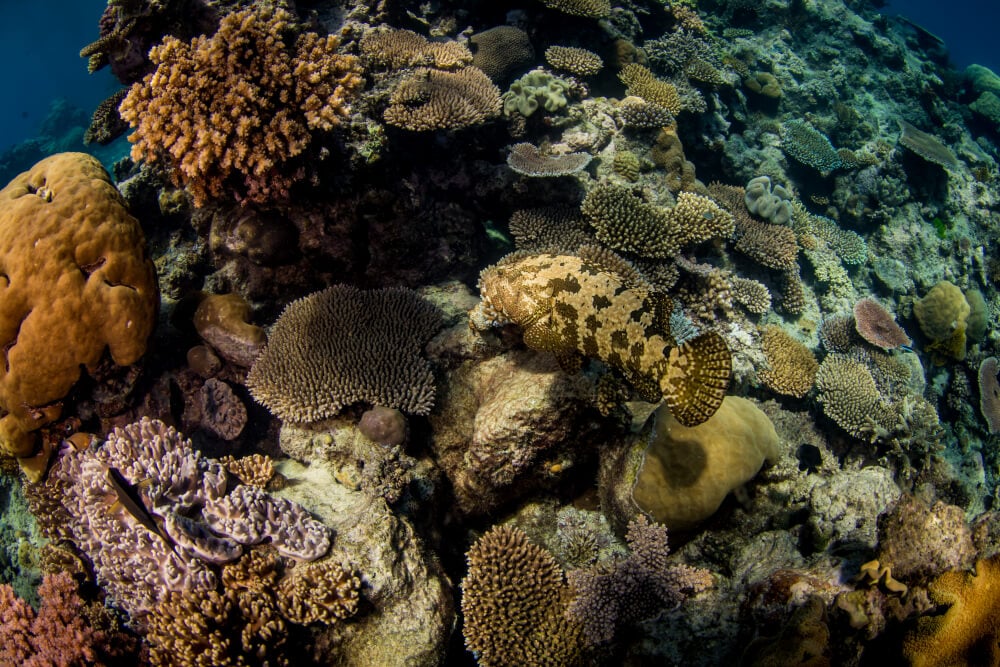
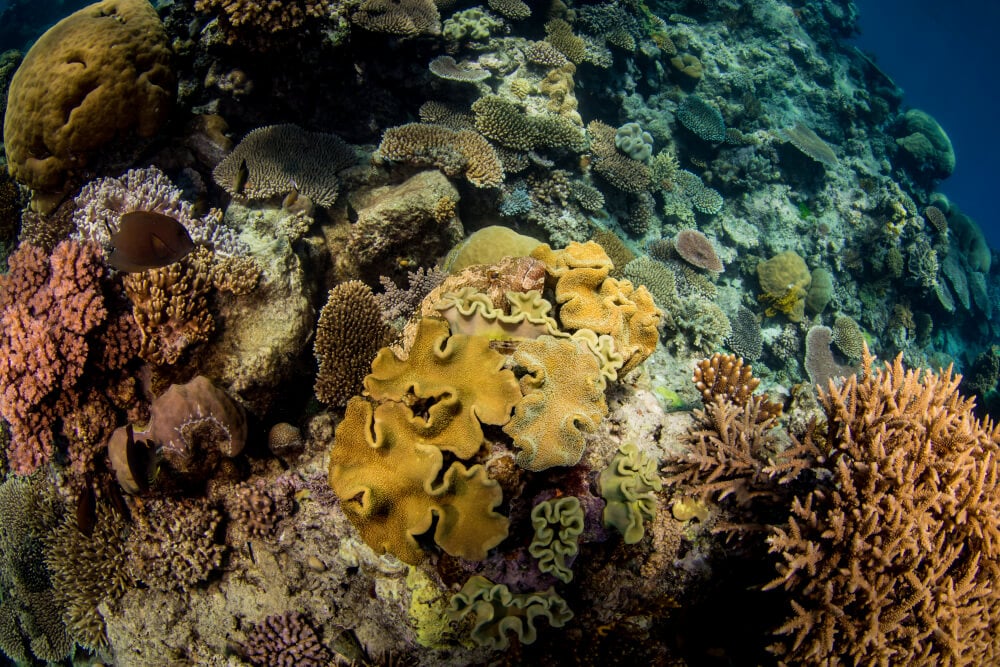
Different growth forms build an intricate three-dimensional habitat.
Branching corals provide shelter for small fish.
Plate and table corals extend across parts of the reef.
Larger rounded coral colonies form substantial structures, while isolated bommies create their own miniature reef communities.
Coral isn’t simply colourful scenery.
It is living architecture.
Over time, generations of coral growth help create the reef structures that provide shelter, feeding areas and nursery habitat for countless other organisms.
Understanding that changes the way you look at the reef.
Instead of seeing a collection of individual corals, you begin to see an interconnected habitat.
Marine Life at Saxon Reef
Saxon Reef supports a diverse community of Great Barrier Reef marine life.
Visitors may encounter butterflyfish, parrotfish, wrasse, damselfish, sweetlips and schools of other tropical reef fish.
Barramundi cod and giant clams are also associated with the reef, while octopus may be found hiding among coral and rocky crevices.
Sea turtles and reef sharks may also be encountered.
But no particular animal is guaranteed.
That uncertainty is part of experiencing a natural ecosystem.
You never quite know what will appear.
Giant Clams
Giant clams are among the Great Barrier Reef’s most remarkable inhabitants.
Their mantles can display striking combinations of blue, green, brown and other colours and patterns.
They also have an extraordinary relationship with microscopic algae living within their tissues. These algae use sunlight for photosynthesis and contribute energy to the clam.
That makes shallow, sunlit reef environments particularly important.
If you see a giant clam at Saxon Reef, admire it without touching it.
It isn’t a colourful rock.
It is a living animal integrated into the reef ecosystem.
Reef Sharks at Saxon Reef
Whitetip reef sharks are among the shark species associated with Outer Great Barrier Reef environments such as Saxon.
They may be seen moving along reef edges or resting around sandy areas.
For visitors nervous about sharks, seeing one in its natural habitat can be surprisingly different from imagining the encounter beforehand.
Reef sharks are part of the ecosystem.
If you see one, don’t chase it or attempt to approach closely.
Give it space and watch.
A shark moving naturally through a coral reef is something worth seeing.
Octopus and the Smaller Reef World
Some of Saxon Reef’s most fascinating animals can be difficult to find.
Octopus are masters of camouflage.
They can alter their appearance remarkably well, blending into coral, rock and surrounding reef habitat.
Look carefully around crevices and beneath ledges.
The same principle applies to many smaller reef animals.
Once you stop looking only for turtles, sharks and large schools of fish, an entirely different Great Barrier Reef begins to appear.
Small crustaceans.
Molluscs.
Tiny reef fish.
Animals hiding within coral.
The reef becomes more interesting the closer you look.
Is Saxon Reef Good for Beginners?
Saxon Reef can provide suitable environments for first-time snorkellers and less experienced visitors when conditions allow.
Shallow coral areas mean you don’t necessarily need to travel far or dive deep to see the reef.
However, suitability depends on the particular location and conditions on the day.
Wind, waves, currents and tides all matter.
Listen to the crew’s briefing.
If you’re not a confident swimmer, tell them before entering the water.
Use flotation equipment if it helps.
There is no benefit in struggling to swim when you could be comfortably floating above the coral enjoying the reef.
Saxon Reef for Certified Divers
Certified divers can explore beyond the shallow areas visible to snorkellers.
Deeper bommies, walls and reef edges provide more complex terrain and the opportunity to search for marine animals occupying different depths.
Good buoyancy control is particularly important.
Coral can be damaged by fins, gauges or other equipment, sometimes without the diver even noticing.
Slow down.
Maintain your position in the water.
Look carefully.
The objective isn’t to cover as much reef as possible.
It is to actually see the reef you’re diving.
Where is Saxon Reef?
Saxon Reef is located on the Outer Great Barrier Reef offshore from Cairns, between Norman Reef and Hastings Reef.
Its position places it among a significant concentration of reef environments accessible from Cairns.
Other reef locations visitors may encounter include Flynn Reef, Milln Reef, Thetford Reef, Pellowe Reef, Breaking Patches, Moore Reef, Michaelmas Cay and Upolu Cay.
Each has its own character.
Some are large reef systems.
Some have particularly strong diving terrain.
Some support pontoons.
Others include natural sand or vegetated cays.
Together they demonstrate just how misleading it can be to think of the Great Barrier Reef as one destination.
It is an enormous collection of different places.
Saxon Reef, Norman Reef or Hastings Reef?
Because Saxon, Norman and Hastings reefs lie within the same broader Outer Reef region, visitors may see all three names when comparing Cairns reef trips.
There isn’t a universally “best” reef among them.
Conditions matter.
One reef may have particularly good visibility or surface conditions on one day, while another may be preferable the next.
Their individual sites also provide different underwater terrain.
For visitors, having an operator with access to several reef locations can therefore be an advantage.
The crew can work with the conditions rather than simply insisting on one location regardless of the day.
When is the Best Time to Visit Saxon Reef?
The Great Barrier Reef can be visited from Cairns throughout the year.
There is no month when Saxon Reef is guaranteed to have perfect visibility or completely calm water.
Wind, tides, currents and recent weather all influence reef conditions.
Conditions offshore can also differ substantially from those in Cairns.
A cloudy morning on the mainland doesn’t necessarily mean a poor day on the reef.
Likewise, blue skies don’t automatically guarantee calm seas.
If Saxon Reef specifically is important to you, check which locations your chosen tour may visit while understanding that final site selection can depend on conditions.
Protecting Saxon Reef
Saxon Reef is a living ecosystem, not an underwater playground built for visitors.
Treat it accordingly.
Never stand on coral.
Don’t deliberately touch it.
Maintain good buoyancy when scuba diving.
Give turtles, sharks and other animals room to behave naturally.
Never remove coral, shells or marine life.
And don’t chase wildlife for photographs.
The best way to experience Saxon Reef is also one of the simplest ways to protect it:
observe without interfering.
Experience Saxon Reef from Cairns
Saxon Reef can be experienced on selected Great Barrier Reef tours departing from Cairns, including itineraries offering snorkelling and scuba diving.
Operators with access to multiple Outer Reef locations may choose between Saxon and neighbouring reefs according to itinerary, weather, currents and conditions on the day.
If Saxon Reef specifically is somewhere you want to visit, check the individual tour’s listed reef locations before booking.
And if Saxon is where the conditions take you, give it your attention.
Float quietly above the coral gardens.
Watch the fish moving between bommies.
Look into the sandy spaces between coral formations.
If you’re diving, explore slowly enough to notice the smaller animals hiding within the reef.
Because Saxon Reef isn’t simply another place to tick off a Great Barrier Reef list.
It is one distinct living community within something much larger, and the closer you look, the more connected it all becomes.




Reviews
There are no reviews yet